You open the reviews and everything sounds… oddly perfect
You click into the reviews expecting a quick gut check, and instead you get wall-to-wall praise: “Amazing quality,” “works perfectly,” “highly recommend.” It reads clean. Too clean. Nothing sounds wrong, nothing sounds messy, and nobody seems to have used the thing in a real house, car, or day-to-day routine.
That’s when people get burned—or stuck scrolling for an hour. Real products create real trade-offs: it fits but blocks a port, it works but the setup is annoying, it’s sturdy but heavier than expected. When every review sounds like a brochure, you don’t need more time. You need a faster filter.
Before you read: two quick filters that decide if the page deserves your time

A faster filter means you don’t “read more,” you check whether the review page earns your attention. Start with the rating distribution. If it’s a cliff—hundreds of five-stars, almost no 2–4 stars—and the product isn’t a simple commodity (like basic batteries), assume the page is noisy and treat the average rating as marketing.
Second, sort by “most recent” and scan just the dates and themes. If the last 20 reviews land in tight clusters (same week) and all say the same vague thing (“great value,” “excellent quality”) with no mention of setup, sizing, noise, battery life, or fit, you’re likely looking at a campaign, not a customer base. You might skip a decent product, but you’ll save time and avoid the polished trap.
If it passes those two checks, then it’s worth reading for what actually happened when people used it.
When five-star praise repeats like a script, what to look for instead
“What actually happened” is exactly what scripted five-star praise avoids. You’ll see the same safe phrases (“great quality,” “works as described,” “highly recommend”) repeated with different usernames, and it’s tempting to treat that as consensus. Don’t. Treat it as low-signal text that could’ve been written without opening the box.
Instead, hunt for friction. Real buyers mention one concrete snag even when they love the product: a clamp that barely fits, a charger that runs warm, an app that needs permissions, a lid that takes two hands. They also anchor claims to a situation: “used it on a 12-hour drive,” “fits my 2018 Civic’s cup holder,” “setup took 10 minutes after updating firmware.” Those details are hard to fake at scale.
The trade-off is speed versus certainty: you might ignore perfectly happy customers who write like billboards. But a page full of billboards isn’t where you learn if this will work in your life, so start looking for reviews that describe a real moment of use.
Specifics are the tell: does anyone describe a real moment of use?
A “real moment of use” usually sounds small and a little inconvenient. Someone mentions where they used it, what they were trying to do, and what they noticed while doing it: “mounted it under my desk and the screws were too short,” “paired it to an iPhone 14 and the left earbud cut out once an hour,” “washed it twice and the logo started peeling at the edge.” That’s the kind of detail that comes from contact with the product, not from copying a listing.
When you scan, look for three anchors: a specific time (“after two weeks”), a specific context (“in a 900 sq ft apartment,” “in a 2019 F-150”), and a specific outcome (“stopped wobbling after tightening the hinge,” “battery dropped 40% overnight”). If a review makes a big claim without any anchor—“life-changing,” “premium,” “best ever”—treat it like it could apply to anything.
Specifics can also flag picky users or one-off defects, so don’t latch onto a single story. Find two or three “moments” that line up, then you’ve got something you can test against the rest of the ratings.
Photos, one-star rants, and ‘almost returned it’ reviews: where the truth leaks out
Once you’ve found a few real moments of use, the fastest way to confirm them is to look for evidence people didn’t bother polishing. Start with customer photos (not brand images). You’re checking scale, finish, labels, stitching, ports—basic “does it match the listing?” stuff. A blurry photo of a frayed seam or a crooked mount tells you more than ten clean five-stars.
Then read a handful of one-star reviews, but don’t absorb the rant. Scan for the failure mode and whether it repeats: “won’t charge after a week,” “arrived used,” “app won’t pair on Android.” If the one-stars are all different and dramatic, that can be normal noise. If they cluster around the same break, that’s a product problem.
Finally, hunt for the “almost returned it” reviews. They usually contain the missing setup step, the real fit issue, or the workaround—and the trade-off is you may be signing up for that extra hassle too.
The pattern test: do the pros/cons match across ratings—or flip randomly?
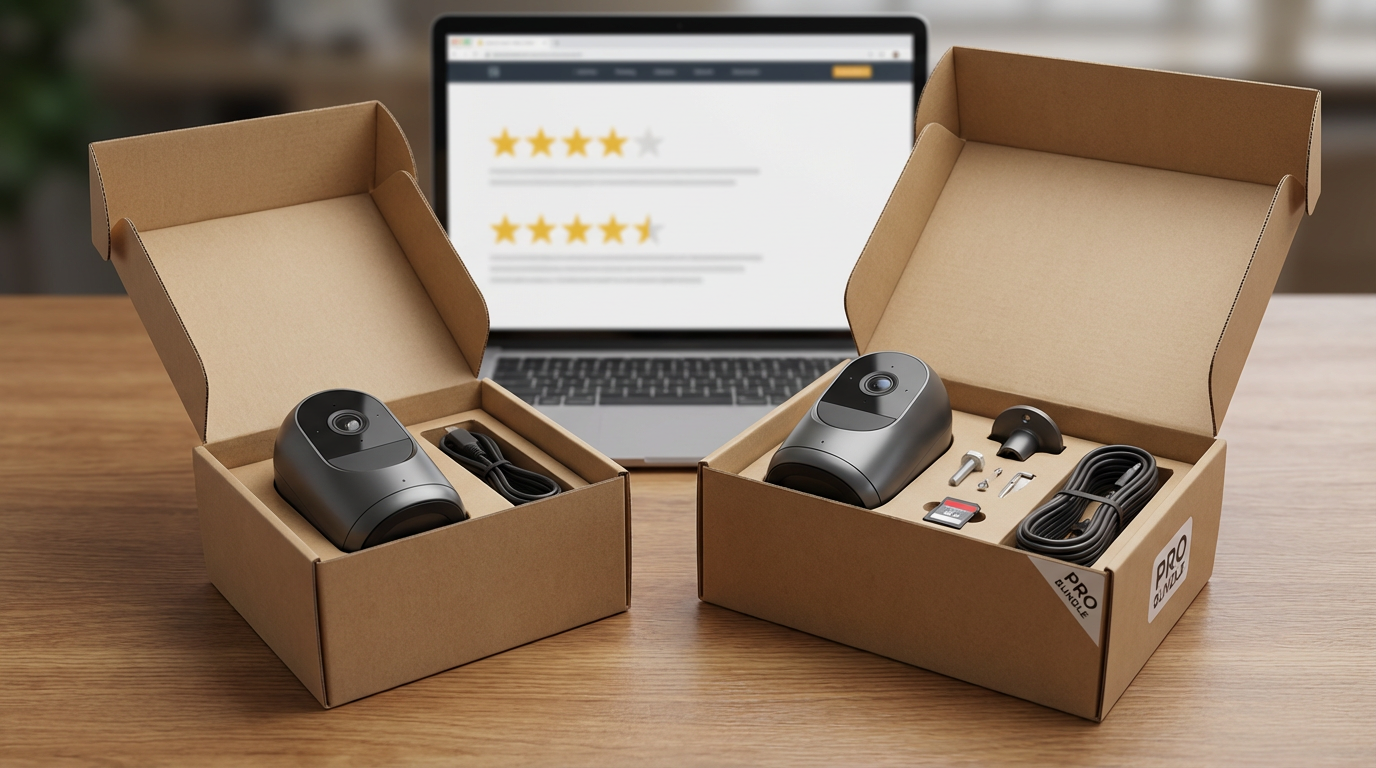
Those “almost returned it” reviews give you a shortlist of real issues—now run the pattern test. Open a few five-stars, a few three-stars, and a few one-stars and look for the same topics showing up with different conclusions. On a normal product, the story stays consistent: “great sound, mediocre mic,” “fits well, app is clunky,” “easy install, adhesive fails in heat.” The ratings change based on tolerance, not reality.
What should make you wary is when the pros and cons flip randomly. If five-stars swear “battery lasts all week” while three-stars say “dies in a day,” and one-stars complain “no charger included” while others praise “great included accessories,” you might be looking at different versions, a listing that changed midstream, or padded reviews that aren’t tied to the product in the box. The trade-off: you may pass on a decent item with a messy listing, but inconsistency is a time sink.
If the patterns hold, you’re close to a decision—now you just need a fast way to act on what you found.
Make the call in 60 seconds: buy, dig deeper, or walk away
A fast way to act is to turn what you just saw into three buckets. Buy if the same two or three pros show up across ratings, the one-stars share a clear (and tolerable) failure mode, and at least a couple reviews include photos or anchored details that match your use case (“fits my model,” “after two weeks”).
Dig deeper if the product sounds good but the listing feels mixed: mentions of “new version,” accessories changing, or reviews that clash on basics like size, battery, or included parts. That’s when you check Q&A, look for a manual photo, or confirm the exact model number.
Walk away if praise reads like templates, dates cluster, and the pros/cons flip randomly. The consequence isn’t just a bad buy—it’s the return hassle you were trying to avoid.