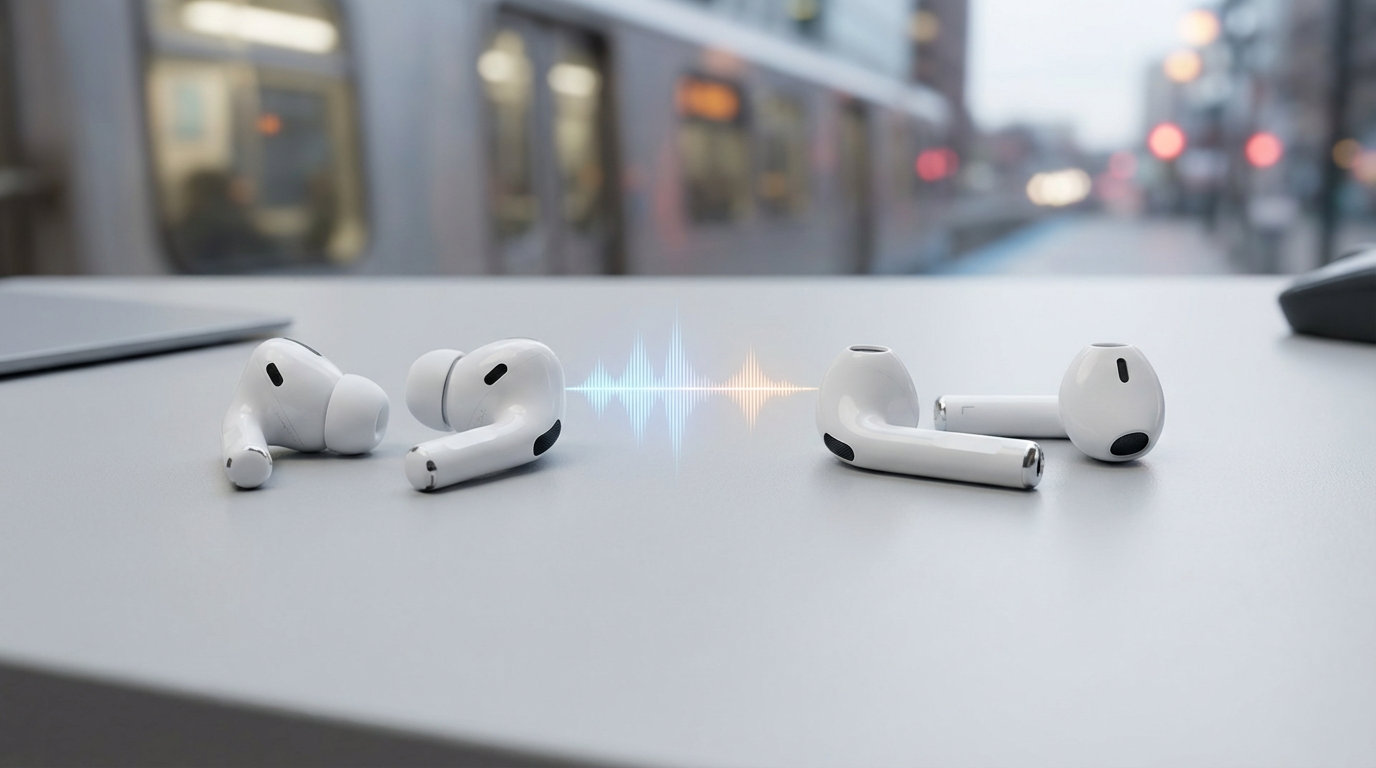
You want noise canceling AirPods—so why do these two feel so close?
You open Apple’s compare page, see “Active Noise Cancellation” on both, and it starts to feel like you’re paying extra mostly for a different name. In day-to-day use, they can overlap: quick pairing, solid transparency, and that familiar AirPods “just works” experience on an iPhone.
The reason they feel so close is that the basics are now shared—and the differences hide in the parts you only notice after a week. Fit is the obvious one, but also how strongly they cut low rumble on a train, how steady your voice sounds in wind, and whether you can change volume without grabbing your phone.
Those details decide if the Pro price is insurance—or wasted money.
The first 10 minutes in your ears: do you need tips, or do you hate them?
That “insurance or wasted money” question usually gets answered in the first 10 minutes—when you realize whether you want silicone tips or you can’t stand them. AirPods Pro 3 use tips to seal your ear canal. If the seal is good, you’ll often feel the sound lock in: bass gets firmer, ANC gets stronger, and you can turn the volume down. The trade-off is you may feel pressure or get that plugged-ear sensation, especially if you dislike in-ear buds.
AirPods 4 (with ANC) sit more like classic AirPods. If you’ve always liked that open fit, they can feel instantly “gone” in your ears. But the consequence is simple: without a full seal, fit can vary more between people. On a walk, a slightly loose fit can make ANC feel inconsistent, and you may bump volume up to compensate.
If comfort is your top risk, fit is the decision—everything else follows from it.
On your commute, which one actually quiets the world more?
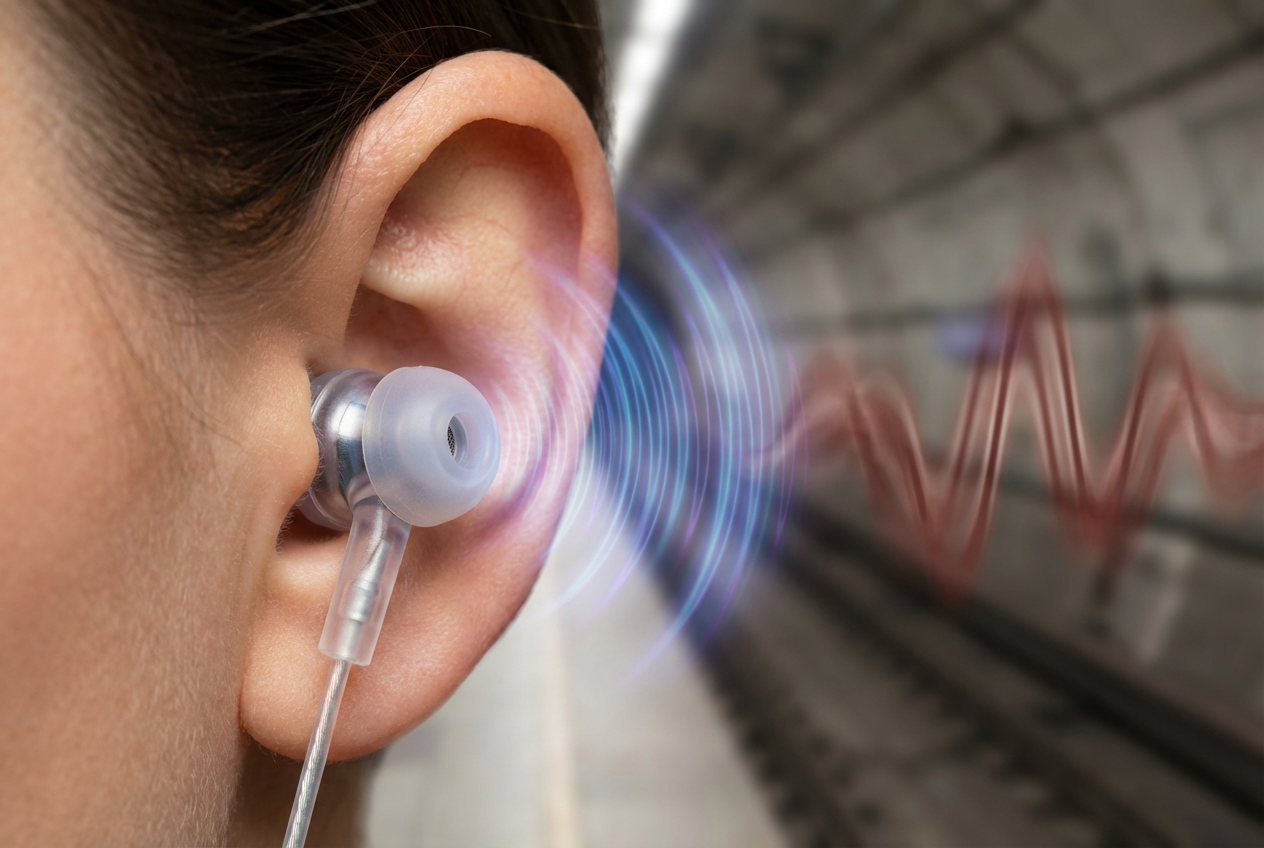
On a commute, that “everything else” shows up fast: subway rumble, bus engine noise, and the constant hiss of air rushing past you. If your earbuds don’t seal well, ANC has less to work with, and you end up hearing the lowest sounds anyway—the stuff that makes a ride feel loud even when no one is talking.
With AirPods Pro 3, a good tip seal usually wins on trains and planes because it blocks some noise before ANC even kicks in. The practical upside is you can listen at a lower volume and still hear detail in podcasts. The friction is that if one ear tip loosens (jaw movement, a hat, sweat), the “quiet” can drop suddenly and you’ll notice the shift.
AirPods 4 (with ANC) can still take the edge off a commute, but results swing more by ear shape. If they sit slightly open, you’ll hear more low rumble and may turn volume up—right when you’ll also want your voice to stay clear on a call.
Calls and voice notes: will people hear you clearly when it’s windy and loud?
That moment you crank volume up on a loud platform is also when you’re most likely to record a voice note or take a quick call—and the noise you’re fighting can end up in your mic. In practice, both models can sound “AirPods clear” indoors, but outdoors you’ll hear the difference in how steady your voice stays when wind and traffic spike.
AirPods Pro 3 usually holds your voice more consistently because the in-ear seal cuts some surrounding sound before the mics and processing try to clean it up. If you’re walking and talking, that can mean fewer “what?” interruptions and fewer calls where you repeat yourself. The trade-off is real: if a tip loosens, your voice level can shift and you may sound thinner until you reseat it.
AirPods 4 (with ANC) can still be totally fine for calls, but the open fit can let more wind and street noise leak in, especially if they sit a bit loose. If you take lots of calls outside, that’s one of the clearest reasons to pay for Pro—right along with how you’ll actually control them mid-call.
Controls, volume changes, and how often you’ll touch your phone
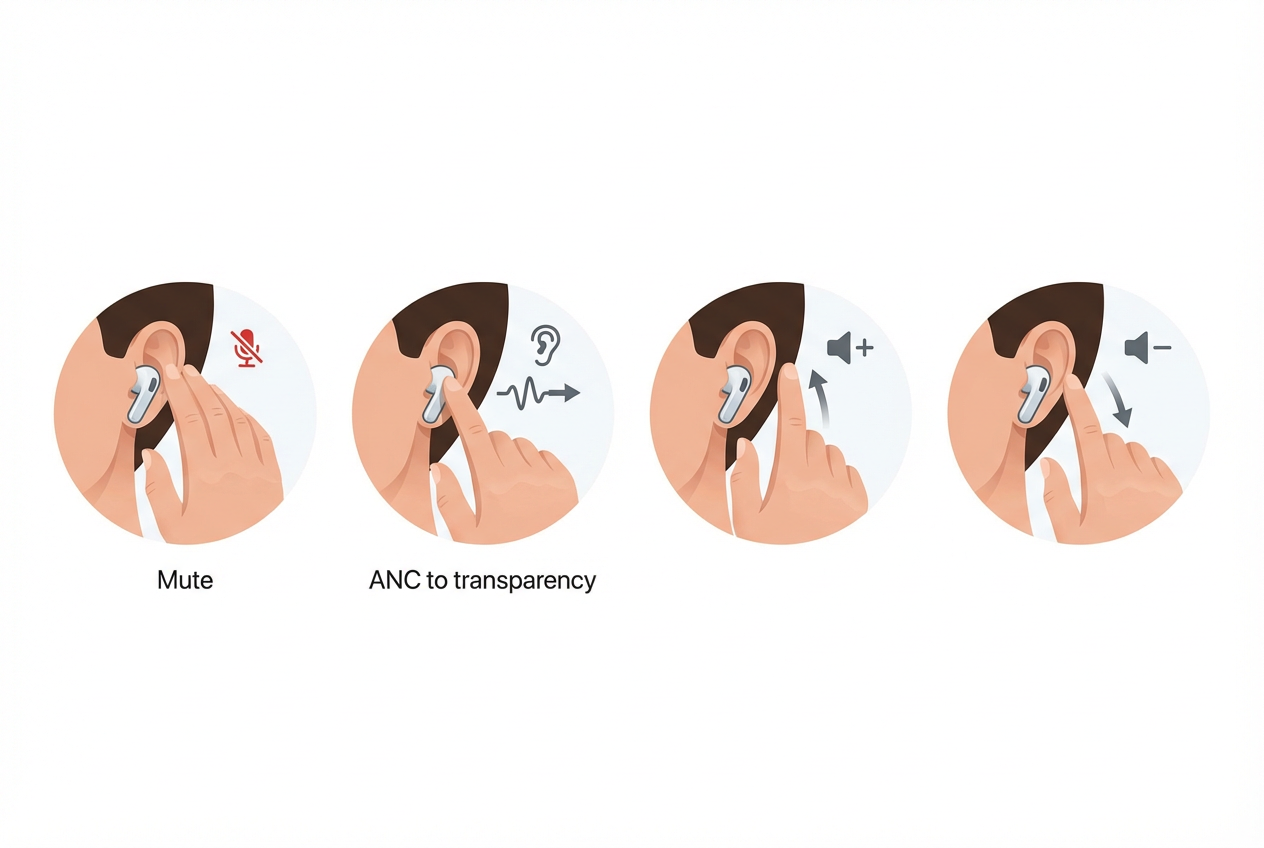
Mid-call, you’re usually doing the same small moves: mute, switch between ANC and Transparency when a barista talks, and adjust volume without breaking stride. If those actions take two tries, you end up pulling your iPhone out—more than you expect—because it’s the fastest “sure thing” when you’re walking or carrying something.
AirPods Pro 3 tends to feel more complete here because you can treat the stem like a tiny remote: press to swap modes, and use the built-in volume gesture to go up or down without reaching for your phone. In everyday use, that matters most on commutes and workouts, where you’re constantly correcting for changing noise. The friction is that stem touches can be finicky with gloves, rain, or sweaty hands, and accidental inputs still happen when you adjust fit.
AirPods 4 (with ANC) covers the essentials—play/pause, calls, and mode switching—but if you can’t reliably change volume on the buds, you’ll touch your phone more often. That might be fine at a desk; it’s annoying the first time you’re juggling a bag and also trying to find your case.
The case you’ll live with: charging speed, tracking, and ‘I lost it again’ moments
That “juggling a bag” moment is usually when the case matters most: you set it down for ten seconds, then you’re patting pockets and checking the seat. AirPods 4 (with ANC) helps with the basics—USB‑C charging, wireless charging, and a built-in case speaker to ping it in Find My—so you can recover it without a silent scavenger hunt.
AirPods Pro 3 pushes harder on the “I lost it again” problem. Apple bakes in a speaker and stronger Precision Finding in the MagSafe case, so you can get closer faster when it’s under a jacket, between couch cushions, or buried in a tote. The trade-off: those extra features only pay off if you actually use Find My, and they add one more thing that can chirp at the wrong time if alerts aren’t tuned.
AirPods 4 (with ANC) also gives you a predictable quick-top-up habit: 5 minutes in the case gets about an hour of listening. If you hate charge anxiety, that detail can outweigh a lot—right before you decide whether “better default” means Pro 3, or “smart spend” means AirPods 4.
So which should you buy today (and when is the cheaper option the smarter flex)?
That “better default” call comes down to how often you’ll hit the edge cases. If you commute on trains, fly, take lots of outdoor calls, or you know tips don’t bother you, AirPods Pro 3 is the safer buy because the seal usually delivers stronger ANC, steadier voice pickup, and more on-bud control—so you pull out your iPhone less.
AirPods 4 (with ANC) is the smarter flex when you want ANC without tips, mostly listen at a desk or on short errands, and value fast top-ups and a simpler fit. The risk is real: if the open fit sits even a little loose, you’ll pay for it in rumble and volume creep. Pick comfort first, then pay for the problems you actually have.